Generous Interfaces
Most collections meet you with a search box.
A grid of thumbnails, a filter or two, and a blank field waiting for a query. It works — if you already know what you are looking for. But you never see the whole. Discovery is gated by what you already know to ask, and the collection's real shape — the curatorial structure an institution spent years building — stays invisible.
Mitchell Whitelaw named the alternative a generous interface: one that shows many things at once. Overview-first, rather than query-first. Browsable. Built to reveal the scale and structure of a collection, and to invite you in.
The idea sits in a long tradition — decades of work showing large hierarchies as trees you can take in at a glance, and letting structure emerge from how things are arranged in space. OneZoom, the zoomable fractal tree of all species, is the closest cousin in spirit. Beautiful work, much of it. But mostly one-offs — a bespoke visualisation for a single collection, not an engine an institution could adopt for its own.
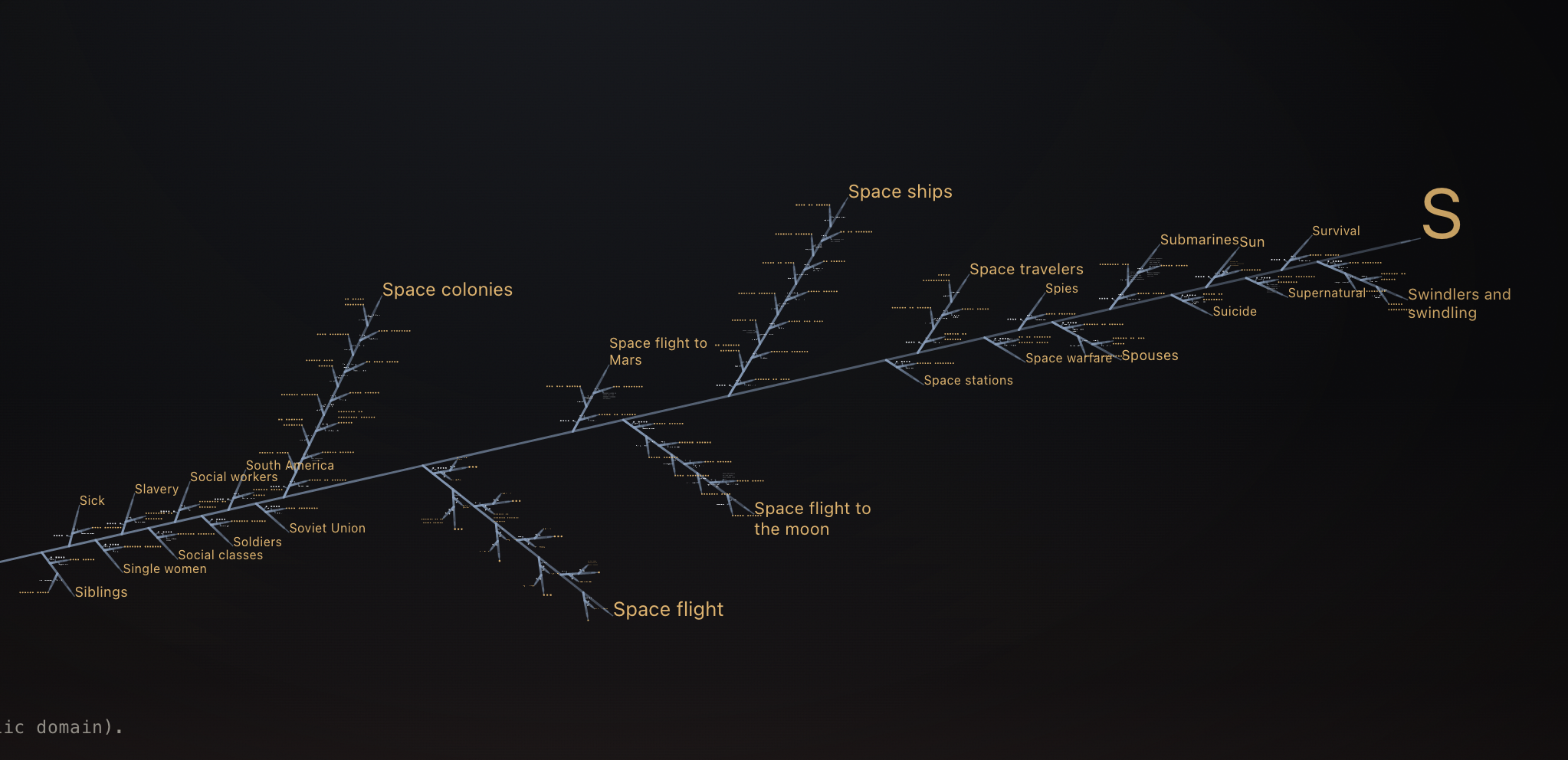
Liefwork is that engine. Your collection's own hierarchy — period, movement, artist, work; or era, subject, author, text — becomes the coral's structure directly. Zoom out, and you feel the shape of the whole. Zoom in, and you reach a single item, and open it. The same engine renders a museum catalogue, a literary archive, or the whole science-fiction shelf of Project Gutenberg; only the content changes.
And it adds what those one-offs never had: the map is not just something to look at. It carries time, and it is a surface a curator — or an AI — can work through and add to.
A generous interface for a collection, and for a mind's working memory.