FAQ
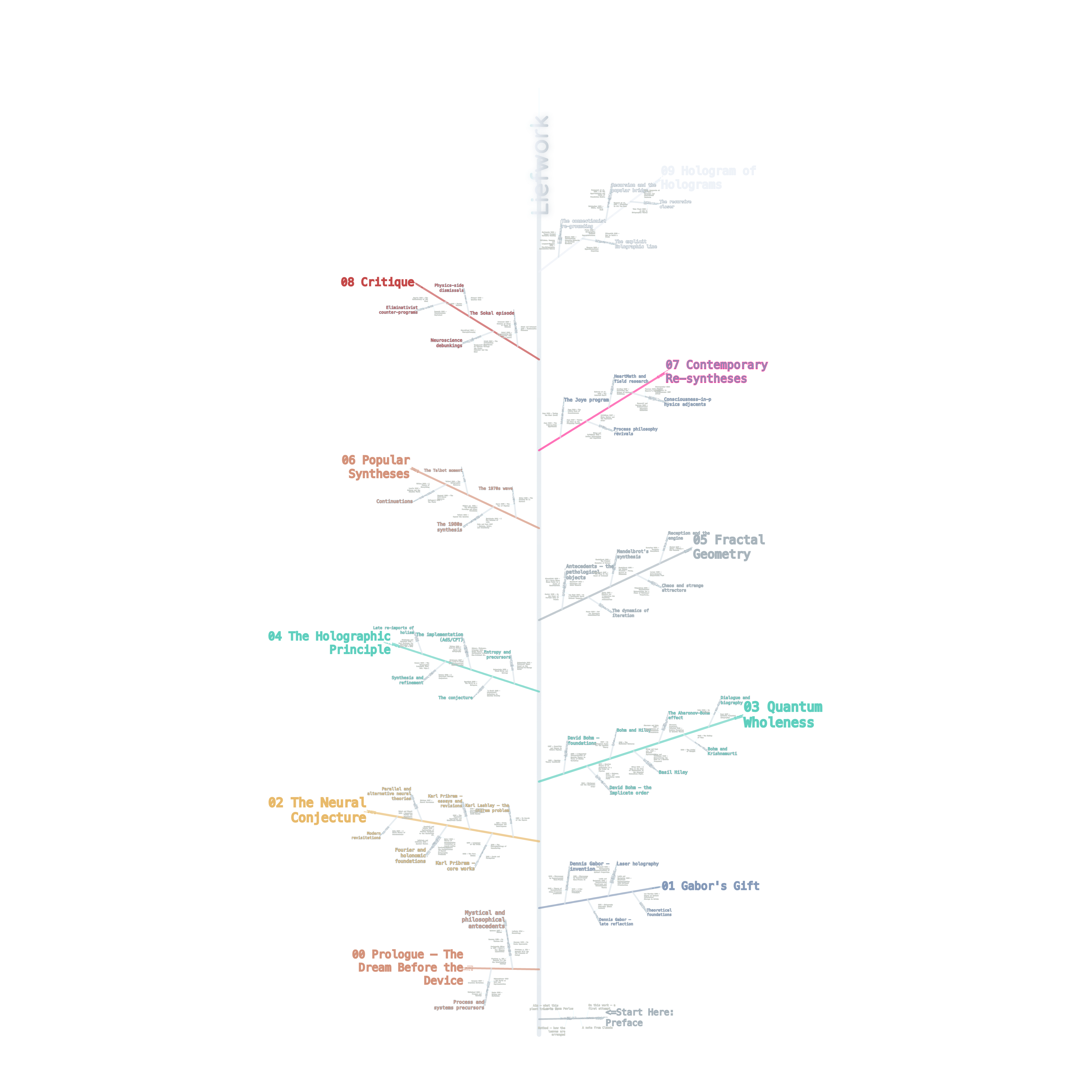
Isn't this just Obsidian's graph view? No. The graph view maps connections — and past a few hundred notes it's a hairball, a tangle rather than a map. A coral maps structure: a legible, chronological tree whose branches summarise themselves, so the overview stays readable at any zoom. It's closer to the file explorer than the graph — the shape of your vault, made visible.
How is this different from the CLAUDE.md or memory file I already keep? A memory file is one flat document the agent reads top to bottom; it grows without limit, and you can't see its shape. A coral keeps the idea and gives it structure: memory lives across a tree of files, each branch carrying a summary at its tip. The agent reads the branch that matters instead of the whole file — and you can see the whole thing as a map. Seeding a coral even starts by writing a Growth Charter — with a CLAUDE.md pointer directing your agent to it (plus AGENTS.md and GEMINI.md, whichever agent you run) — so it builds on what you already do rather than replacing it.
Does it actually work as memory, or is it just nice to look at? Early results say it works. On LongMemEval, a standard benchmark for long-term memory, an agent working from a coral answered correctly more often than one handed the entire history to read — while reading a fraction of the tokens per question. The sample is small and it's early days, but the direction is consistent: orient on the branch that matters, and you don't pay to re-read the rest.
Which agent does it use? Do I need an API key? The terminal agent you already run — Claude Code, Codex CLI, or Gemini CLI. Liefwork launches it and turns the coral into a live view of its work. There's no API key to paste and no separate credits to buy. And because a coral is just plain Markdown, your memory isn't locked to any one model — switch agents and it comes with you.
Where does my data live? Is it private? In your vault, as plain Markdown you already own. Liefwork reads and grows those files in place; nothing is uploaded, and there's no account to create. The only thing that leaves your machine is the agent calls you choose to make.
Do I need Obsidian? Yes. Liefwork is an Obsidian plugin and runs inside your vault, on the desktop app (1.6.6 or later).
What does it cost? The core is free and fully functional — no trial, no locked features. There's a Pro upgrade for a one-time €5.99: a few easter eggs, and a way to support an independent developer. No subscription, and Core stays whole whether or not you buy it.
What does "Early Access" mean? Liefwork's core works and is in daily use, but rough edges remain and things will keep changing. We'd rather say so than pretend otherwise. The User Guide covers what ships today, including its current limits.