The Graph View Obsidian Deserves
For many people the graph view is the first thing they love about Obsidian, and the first they stop opening. Past a few hundred notes it tangles into a hairball — every note a dot, every link a thread — and the shape of your work disappears into the noise.
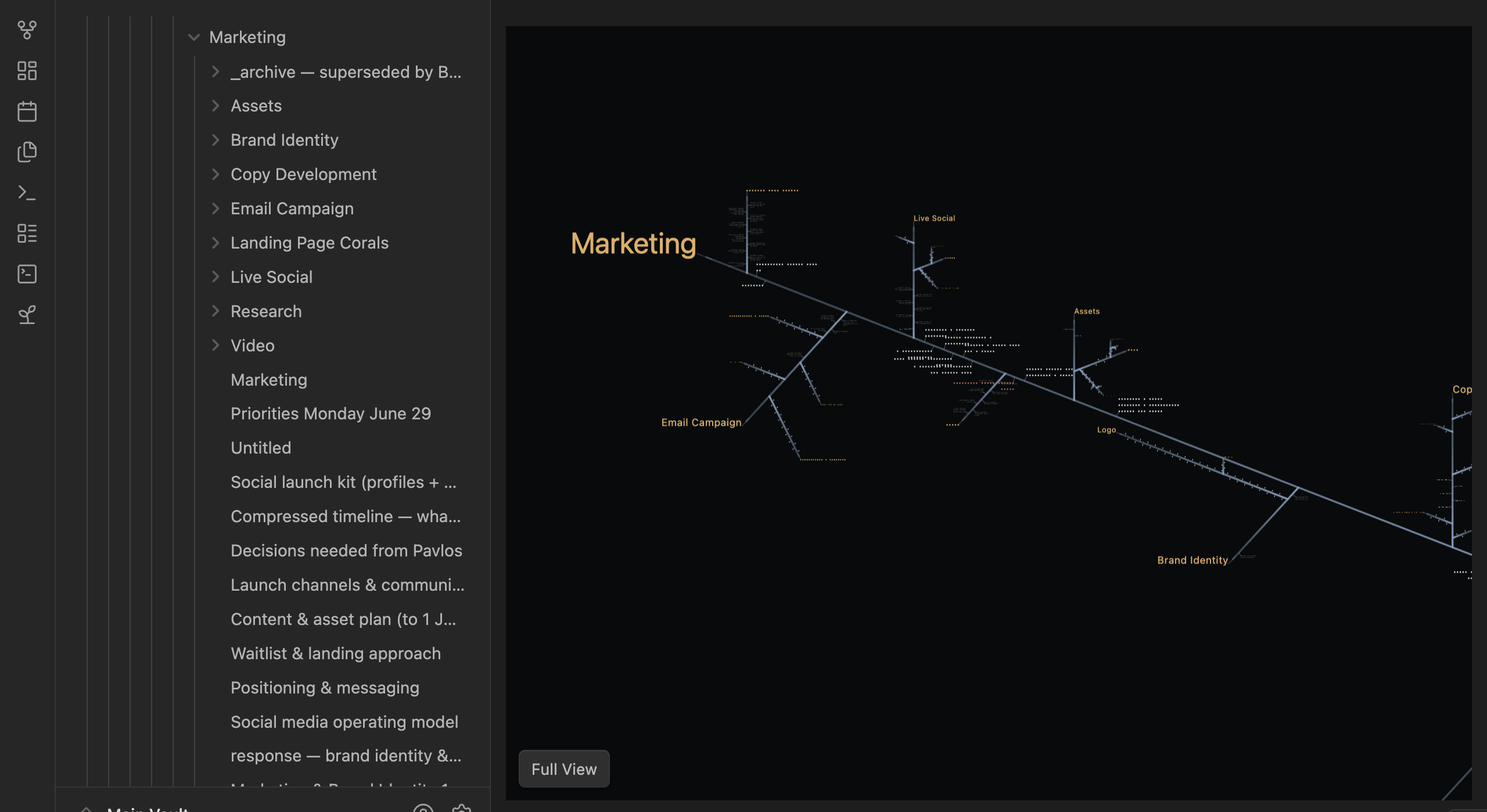
A Liefwork is a different view of the same vault. It reads the structure your folders already hold and renders it as a branching shape: every folder becomes a branch, every file becomes a "lief". Nothing is placed by hand. The map is grown from your data, so its shape is your data's shape.
Structure is what the file explorer is for — the folder tree down the side of your vault. But it gives you names in a list, not the shape they make: collapsed, it hides everything but the path you have open; expanded, a large vault becomes an endless scroll. A Liefwork turns that inside out. Every file sits on the branch that made it, and the whole structure is visible at once — a shape you take in, not a list you parse.
Your files never move. Liefwork reads what is already on your disk and renders it; nothing is copied or rewritten, so closing the plugin leaves your vault exactly as it was.
What you get is not a diagram of your vault but a surface you can work on. Because the structure is fully exposed, the map itself becomes the interface: you read, edit, and add where the work sits, instead of hunting for it through nested folders.
It holds at any size. A dozen files read as a sprig; a corpus of thousands reads as a reef. Zoom out and the backbone stays legible; zoom in and every lief is still in its place. Nothing collapses behind a fold.
This is what a Liefwork is — your structure, revealed. Give it a memory system, and it becomes a place an AI agent can work and remember. That is a Memory Coral, and it is the next page.