The Liefwork AI Memory System
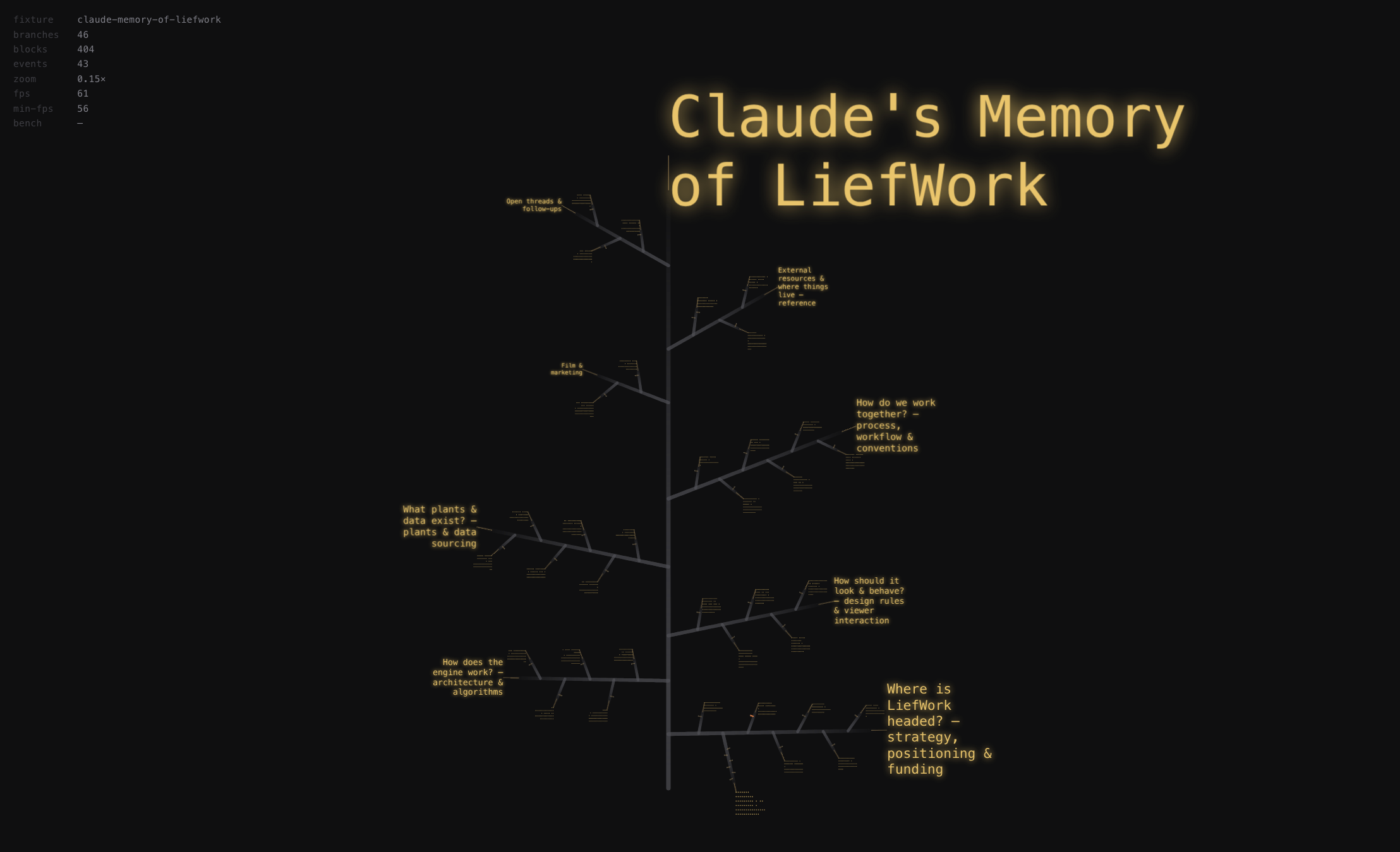
Liefwork reveals the structure of your data. Implement the Liefwork Memory System, and that structure becomes a place an AI agent can work — and remember. This is a Memory Coral.
Biological corals are a symbiosis between an animal and algae. The photosynthetic algae fuel the coral's growth. In return, the coral animals build the algae a home, a shelter from the chaos of the open ocean.
AI agents today are highly capable, but forgetful and homeless. They answer, then lose the thread; their memory, when they have it, is a store often hidden from view. A Memory Coral turns that around: the memory is the structure itself, the substrate on which you and your agent work.
You seed a project folder with a few growth rules. From then on the agent grows the coral as it works: each prompt-response exchange is logged and every branch keeps a summary at its tip (the meristem) of the work done and key outputs.
Those summaries at the tip of every branch are what makes the memory cheap to use. An agent drops into a subtree, reads the meristems, and is oriented. It consults the detail below only when it needs to; it does not re-read everything to know where it is.
This means that as the work grows, the cost of finding your place barely moves: in our testing, orienting with Claude Code Opus 4.8 settles at around 11K tokens whether the coral holds a week of work or a year of it. On the Liefwork project coral itself (over 1,400 notes and 400 MB), this comes at roughly 190× less than handing the agent the whole history to read.
And on LongMemEval, a standard benchmark for long-term memory, an agent in a Memory Coral answered correctly more often than an agent handed the entire history to read — while reading a fraction of the tokens per question. (Note: the sample is small, but the direction is consistent).
Because the memory is only files, it is not locked to any one agent. Claude Code, Codex, Gemini — whichever terminal agent you use reads the same summaries and orients. You can switch from one model to another and still pick up right where you left off. And because you read it too, you can see and control exactly what an agent remembers. There is no hidden store to take on trust, no complex index only an agent can parse.
It is not the agent that is remembering. The memory is the structure; the agent navigates it simply by following the map left by its predecessors.
Keep Track of Multiple Agents
With Terminal installed, through Liefwork you can also launch agent terminals on specific branches (folders). Each terminal and the branch it is on glow with the same colour so you can keep track of where each terminal agent is working.