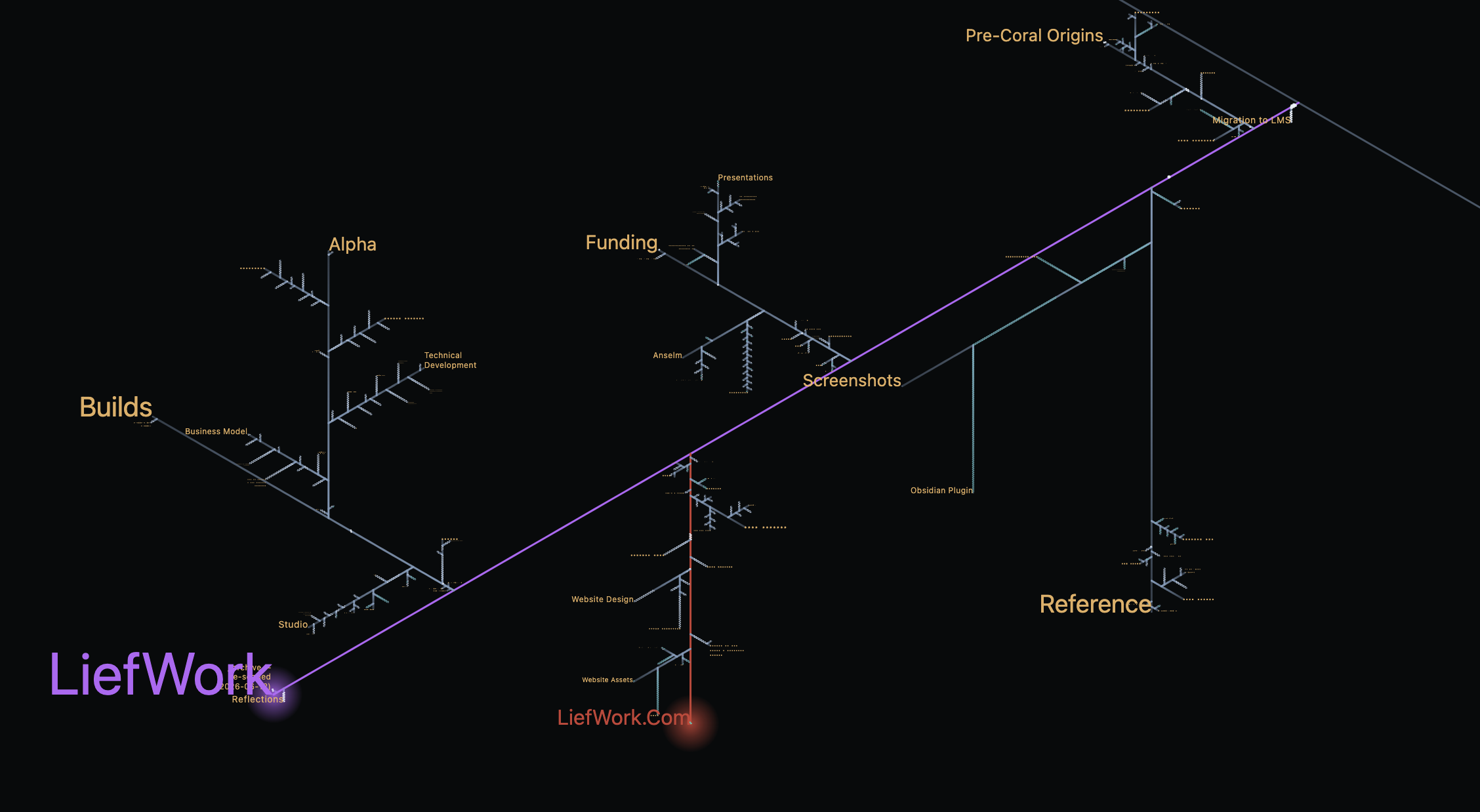
Why put files on branches?
What is gained by portraying file systems as growing plants?
First, let us note that the file system that we know and love - of folders containing files and subfolders - is itself a metaphor.
Files do not literally sit inside folders on your hard drive (or cloud server). Files are linked to directory entries as a form of organisation. These are then dubbed "folders" and we pretend the files are inside them.
The clickable folder as a concept came into existence in the 1970s as engineers sought ways to make computing accessible to the average household using easily understandable concepts. And it made a lot of sense.
But the folder metaphor is also limiting. Its visual architecture is one that grows inwards - boxes within boxes within boxes. This means that the contents of any given folder are hidden by default. To see them, you need to open that particular folder. And in most views you cannot have more than one folder path open at the same time.
An exception is the folder tree which allows all contents to be expanded at once. But for large projects this leads to enormous scrolls and folder nesting that is challenging for the human eye to parse.
Liefwork corals, in contrast, present a structure in which all elements have their own space and position. Folder hierarchies are still clear: branch/child branch replaces folder/subfolder. But now the actual shape of the data is also visible down to the last file - which branches have many children, and which do not. The structure tells its own story.
This visual paradigm also opens new ways of working and collaborating. Our data, ultimately is the surface on which we act & create. But precisely because it is hidden inside folders, we often rely on additional organisational and display tools to manage it.
Revealing it as a single shape allows the data itself to become its own dashboard or surface for collaborating with teams or AI agents. Project planning and file organisation become the same task; a table of contents becomes the backbone for the work to create the book.
And for large corpuses such as reference works or collections, the Liefwork system becomes a "generous interface" - an open structure where visitors can wander as through the halls of a library, the size of each wing telling its own story.